
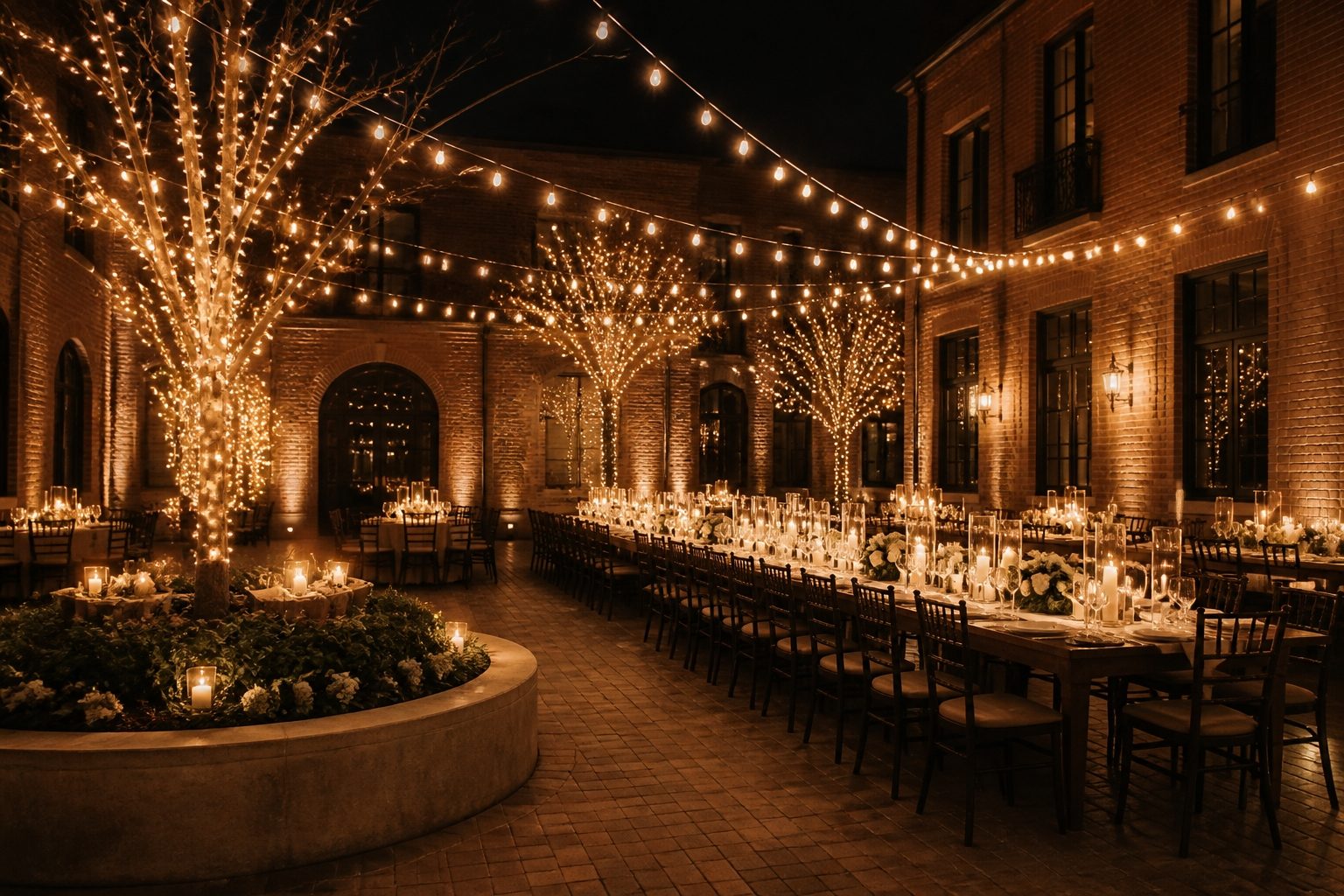



Home/Holiday & Event Lighting
Year-round · Norton
Holiday & Event Lighting in Norton
Christmas is one night in twelve months. The rest of the year has Hanukkah, Halloween, July 4th, weddings, corporate parties and store openings — and each one has a different lighting problem.


Local guide · Holidays & events
Permits for events in Norton
For an exterior-lighting installation, the event footprint matters more than the fixture count. A private-house façade display is a different proposition from a wedding rig, queue, generator, tent, or cable route that reaches public space or changes circulation near Norton Center or a business corridor.
| FOOTPRINT | PLANNING QUESTION | INSTALLER INPUT |
|---|---|---|
| Private property | Does the setup remain on-site? | Fixture locations and load plan |
| Public-facing event | Does it use municipal ground or affect access? | Layout, cable routes and strike time |
| Tent or generator | Does a temporary structure or fuel source apply? | Dimensions, anchoring and power schedule |
- Client-led approvals: The host or event organizer retains responsibility for applications and site permissions; an installer supplies the rigging points, electrical load, dimensions, and installation and removal schedule.
- Corridor conditions: The Town identifies interrupted sidewalks and wide curb cuts along portions of the West Main Street planning corridor, making pedestrian routing part of the site plan.
- Early coordination: A late change from façade lighting to a tented, powered guest area can alter the review path and the equipment plan.
Reserving Parks, Plazas and Public Buildings in Norton
A reservation grants use of a location; it does not automatically authorize tents, temporary wiring, generators, staking, vehicle access, or attachments to buildings and trees. Event layouts should protect turf and keep guest circulation clear, especially where open-space settings meet wet or soft ground after rain.
- Separate the scopes: Confirm site access with the property operator, then coordinate temporary structures and power as their own workstreams.
- Plan for weather: The Town identifies precipitation-related flooding as a local concern, and the Norton municipal vulnerability report notes the community’s extensive wetland and stream resources.
- Use protective staging: Cable ramps, non-penetrating bases, and deliberate load-in routes help avoid lawn damage and keep a site serviceable during setup and strike.
- Recurring dates: Community calendars, institutional functions, and returning events can narrow preferred-date availability well before the lighting plan is finalized.
Fire Marshal Requirements for Tents, Stages and Temporary Structures
Temporary event structures need to be treated as short-life buildings: their fabric, anchoring, exits, aisle paths, heaters, and nearby fuel all affect the lighting design. The applicable safety review should be coordinated before drape, string runs, uplights, or distribution equipment are installed.
| STRUCTURE | SAFETY REVIEW FOCUS |
|---|---|
| Tent or canopy | Fabric documentation, anchoring, exits and clear access |
| Stage or riser | Stable surfaces, guards and egress routes |
| Heater or fuel-powered equipment | Placement, fuel handling and separation from guests |
| Decorative lighting | Attachment method, heat control and unobstructed exits |
- Wind and ballast: Lighting cannot be used as tent ballast or attached where it compromises the structure manufacturer’s system.
- Exit discipline: Café strings, drape lighting, and feeder cable routes must not narrow an intended exit or create a snag point.
- Fire-safety coordination: Review the Massachusetts fire code information before finalizing fabric décor, heaters, fuel-powered equipment, or temporary structures.
Street Closures, Noise and Light Curfews in Norton
One evening can operate on three separate clocks: access restrictions, sound management, and the time required to remove equipment safely. A generator at the curb, amplified entertainment, a lift, and a late strike each require a site plan that respects neighbors and maintains safe passage.
- Street-facing setups: Keep cable crossings, delivery vehicles, and temporary fixture bases out of travel paths unless the event plan specifically provides for them.
- Measured impacts: Generator placement and amplified sound should be considered together because both can affect nearby homes and businesses.
- Load-in reality: A lift-assisted installation needs room for setup, work positioning, and removal; it is not simply an extension of guest arrival time.
- Light spill control: Aim fixtures downward, shield the visible source, avoid shining into windows, and switch off decorative lighting after the event rather than leaving a façade wash running overnight.
- Local circulation: The Town’s West Main Street Rapid Recovery Plan highlights pedestrian gaps and access challenges that matter when an event affects a commercial frontage.
Temporary Power and Generator Permits for Outdoor Events
Temporary power is the quiet operational work that can determine whether an event opens on time. Loads should be calculated from the actual lighting, catering, audio, refrigeration, and tent requirements rather than estimated from outlet count alone.
- Separate circuits: Decorative lighting should not compete with catering appliances, sound equipment, or essential event operations on an overloaded run.
- Wet-weather readiness: Use listed outdoor equipment, wet-location components where exposed, protected connections, and cable management that keeps pedestrian routes clear.
- Licensed work: Hardwired temporary work and alterations to electrical equipment belong with a qualified electrician and the required electrical review.
- Generator placement: Position equipment for service access and ventilation while keeping exhaust, noise, fuel handling, and guest routes in the event plan.
- Electrical baseline: The Massachusetts electrical code resources provide the state framework for safe electrical installations.
Neighborhoods we serve in Norton
Holiday and event lighting plans vary sharply between residential properties, pedestrian-oriented commercial frontages, and larger employment sites. We design around access, surface conditions, guest movement, and the scale of each property.
- Norton Center: Campus-adjacent and civic activity calls for clean cable routing and deliberate fixture placement around pedestrian approaches.
- Village Center: Compact commercial and residential patterns favor storefront lighting that supports an event without washing neighboring homes.
- Chartley’s Corner: Roadside businesses and gathering spaces benefit from visible entry lighting with controlled glare toward approaching traffic.
- West Main Street corridor: Mixed uses, curb cuts, and uneven sidewalk continuity make load-in timing and guest circulation central to the installation plan.
- Norton Commerce Center: Larger commercial parcels can accommodate corporate-event power distribution, branded façade lighting, and organized vendor staging.
- Blue Star Business Park: Industrial and wholesale properties offer room for employee events and openings, but require a clear separation between work areas, vehicles, and guest-facing lighting.
Plan ahead
Tell us the date and the space.
We will tell you what is possible, what it costs and how long it takes to strike. Most event quotes go out within two business days.